
Quantum Starter References: Quantum Computing Systems and Components – Superconducting Qubits
Great sources from around the web to start learning about quantum concepts.

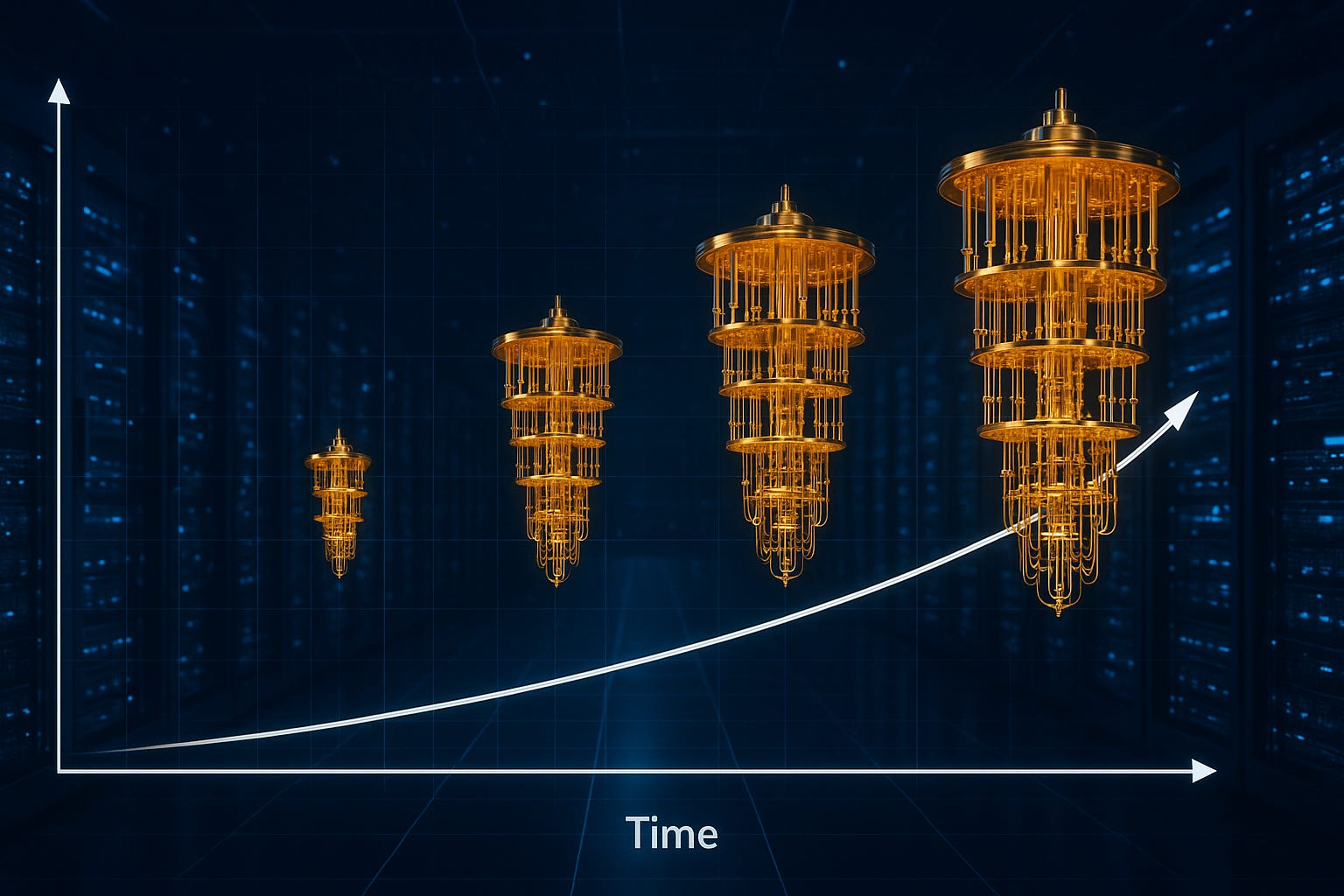
Image credits: ChatGPT
Last Updated on Friday, June 19, 2026, at 04:01 PM EDT
Our Daily Quantum Update breaks down recent news into categories to make it easier for you to find the industry developments in which you are most interested. These articles don’t always explain what the core technology is or how it works. Luckily for us, there are some great resources on the web that do.
In each installment of this type of post, we’ve listed some of the best explainer pieces by authors like Russ Fein and Martin Ivezic, as well as by companies developing the technologies. For the latter group, we’ve tried to pick content rich in understandable technical signals and low in marketing noise.
We have not included deep research articles in these collections, though there might be a good survey article that sneaks in. We’ve tried to include content for beginners, enthusiasts, marketers, investors, policy makers, and, really, anyone who wants to learn more about the topic. Scan the listing and start with something that appeals to you. Jump around until you find something that is at your level of understanding and interest. The newest articles are at the top, with older ones appearing lower as you go.
By our most recent count, there are 97 companies that build quantum computing processor units, and 31 of those use the superconducting modality. The best-known are probably IBM and Google, but clearly, many others believe it is a winning choice.
The modality is not without its faults. Speaking generally, the qubits are very fast, but the coherence time, the time you have to do useful things, is relatively short. Many implementations have a reputation for being very noisy, meaning that over time, as you perform operations, data is lost due to errors creeping in. Could this be why Google decided to also pursue neutral-atom qubits?
Superconducting quantum computing
A branch of quantum computing that implements superconducting electronic circuits as qubits in a quantum processor, typically microwave-frequency circuits containing Josephson junctions fabricated on solid-state chips.Published or Last Updated: June 2026
Source: WikipediaIBM Quantum Computing | Hardware and roadmap
Explore IBM Quantum hardware, including our latest quantum processors, systems, and plans for the future.Published or Last Updated: June 2026
Source: IBMTaxonomy of Quantum Computing: Modalities & Architectures
Why multiple quantum computing paradigms? The goal is the same – realize a scalable, universal quantum computer – but the approaches differ.Published or Last Updated: May 2026
Author: Marin Ivezic
Source: PostQuantum.comCat Qubits: Built-In Error Protection for Quantum Computing
Cat qubits resist bit-flips for over an hour and could cut QEC overhead by 200×. How they work, who builds them, and what this means.Published or Last Updated: May 2026
Author: Marin Ivezic
Source: PostQuantum.comSuperconducting Qubits: How They Work, Who Builds Them
From transmons to fluxonium, superconducting qubits lead the race to a CRQC. Vendor map, gate fidelities, QEC milestones, and what it means.Published or Last Updated: May 2026
Author: Marin Ivezic
Source: PostQuantum.comQubit Modalities: Superconducting Quantum Computing
Third in a series focused on various quantum modalities and companies — including an “Alpha Dog” and a “Breakout Contender” for each modality.Published or Last Updated: April 2026
Author: Russ FeinFluxonium: The Qubit Behind Qilimanjaro’s Quantum Computers
How fluxonium qubits work and why they sit at the heart of Qilimanjaro’s quantum computers — covering qubits, Josephson junctions, the transmon, and fluxonium’s advantages in coherence and anharmonicity.Published or Last Updated: April 2026
Author: Guillem Biarnés
Source: Qilimanjaro Quantum TechIQM Quantum Tech - Tech Stack
IQM’s quantum tech stack includes everything needed to operate your computer, from hardware and processors to software and calibration tools.Published or Last Updated: January 2026
Source: IQM Quantum ComputersTutorial on Superconducting Quantum Circuits: From Basics to Applications
A self-contained, undergraduate-level pedagogical introduction to superconducting quantum circuits, covering superconductivity, the Josephson effect, circuit quantization, circuit QED, and the transmon qubit, with a numerical simulation of vacuum Rabi oscillations.Published or Last Updated: December 2025
Authors: Denys Derlian Carvalho Brito, Fernando Valadares, and André Jorge Carvalho Chaves
Source: arXivQuantum Computing Modalities
A Qubit Primer Re-Revisited in December 2024 — a summary of different quantum computing modalities including relative strengths and weaknesses.Published or Last Updated: December 2024
Author: Russ FeinMeet Willow, our state-of-the-art quantum chip | Google
Our new quantum chip demonstrates error correction and performance that paves the way to a useful, large-scale quantum computer.Published or Last Updated: December 2024
Author: Hartmut Neven
Source: GoogleEncoding Quantum Information in States of Light | Alice & Bob
What is a cat qubit from the photonics perspective? Superconducting quantum computing explained using common photonics analogies.Published or Last Updated: October 2024
Author: Nathanaël Cottet
Source: Alice & BobPotential and challenges of quantum computing hardware technologies
Many qubit technologies could shape the future of quantum computing hardware. Here, we take a closer look at five of the major qubit technologies: photonic networks, superconducting circuits, spin qubits, neutral atoms, and trapped ions.Published or Last Updated: December 2023
Authors: Martina Gschwendtner, Niko Mohr, Nicole Morgan, and Henning Soller
Source: McKinsey & CompanyPractical Guide for Building Superconducting Quantum Devices
A tutorial covering the physics of circuit quantum electrodynamics, quantum circuit design, device fabrication and characterization, and pathways toward robust large-scale superconducting quantum computing.Published or Last Updated: November 2021
Authors: Yvonne Y. Gao, M. Adriaan Rol, Steven Touzard, and Chen Wang
Source: PRX QuantumTutorial: Gate-based superconducting quantum computing
An introduction to the basic conceptual elements needed to understand and build a gate-based superconducting quantum computing system, published in Journal of Applied Physics 129, 041102 (2021).Published or Last Updated: January 2021
Authors: Sangil Kwon, Akiyoshi Tomonaga, Gopika Lakshmi Bhai, Simon J. Devitt, and Jaw-Shen Tsai
Source: arXiv
Sutor Group Intelligence and Advisory
Dr. Bob Sutor is CEO and Founder of Sutor Group Intelligence and Advisory. Drawing on more than four decades of experience across startups and large corporations, Sutor Group advises Deep Tech startups, enterprises, governments, and investors on quantum technologies and other emerging fields, pairing market insight with deep technical expertise.
The firm shares its work through client engagements, seminars, reports, newsletters, books, media appearances, and speaking and panel moderation at leading industry conferences and client events.
Legal Stuff
Visit the Copyright, Notices, Disclosures, Disclaimers, and Licenses page on the Sutor Group website for applicable legal information for this content.