
Quantum Starter References: Quantum Computing Systems and Components – Trapped Ion Qubits
Great sources from around the web to start learning about quantum concepts.

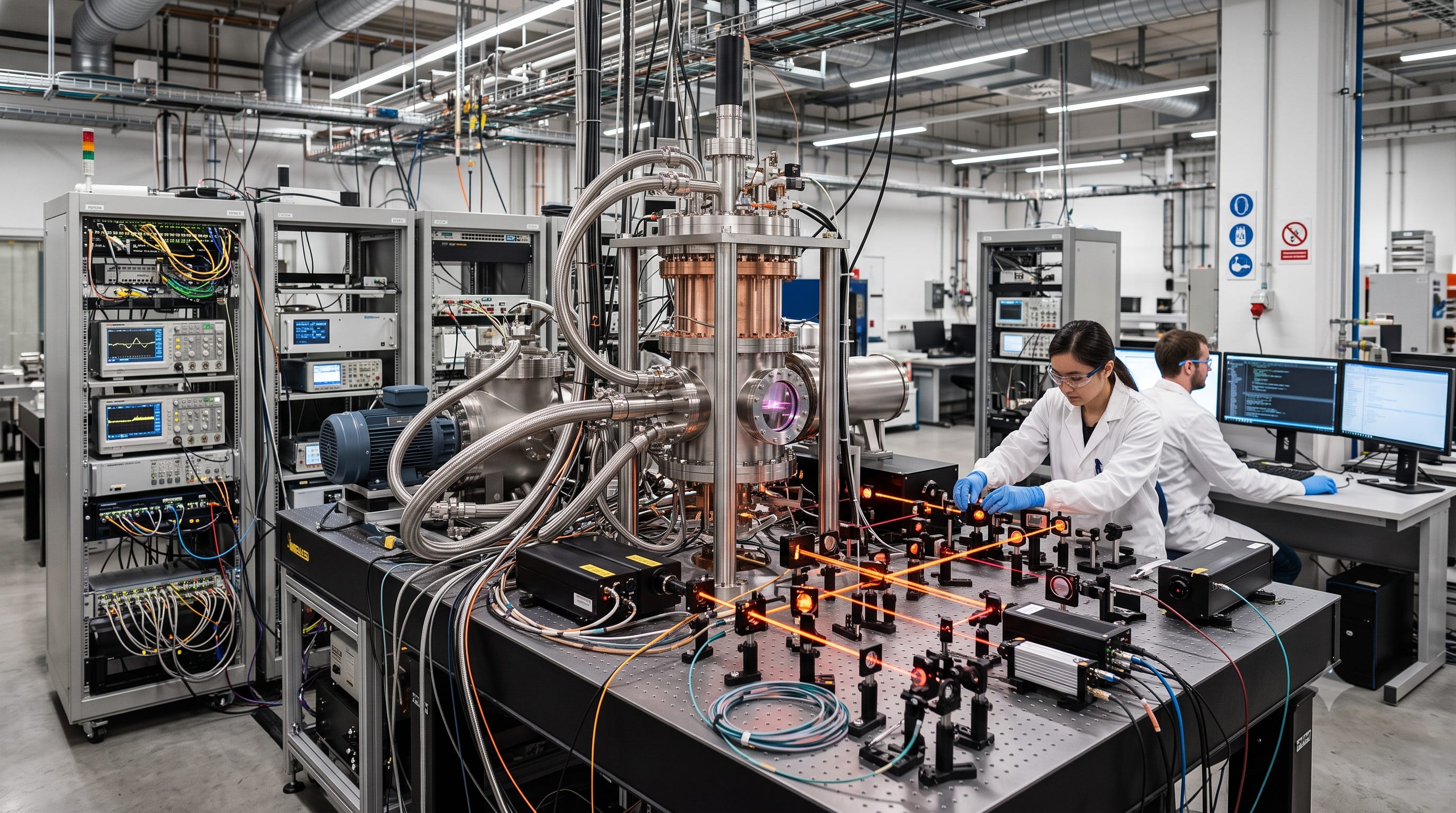
Image credit: Google Gemini
Last Updated on Saturday, June 27, 2026, at 11:44 AM EDT
Our Daily Quantum Update breaks down recent news into categories to make it easier for you to find the industry developments in which you are most interested. These articles don’t always explain what the core technology is or how it works. Luckily for us, there are some great resources on the web that do.
In each installment of this type of post, we’ve listed some of the best explainer pieces by authors like Russ Fein and Martin Ivezic, as well as by companies developing the technologies. For the latter group, we’ve tried to pick content rich in understandable technical signals and low in marketing noise.
We’ve tried to include content for beginners, enthusiasts, marketers, investors, policy makers, and, really, anyone who wants to learn more about the topic. Scan the listing and start with something that appeals to you. Jump around until you find something that is at your level of understanding and interest. The newest articles are at the top, with older ones appearing lower as you go.
Below the article links are references to other modalities covered in this series.
Trapped-ion quantum computing is one of the dominant quantum computing modalities, known for its low error rates but also for its slowness. It has not scaled as quickly as neutral-atom and superconducting approaches. This is promised by public companies like Quantinuum and IonQ, though reaching thousands of qubits only exists on roadmaps with exponential growth coming “real soon now.” Nevertheless, much of the science and engineering appears to be sound, even if the milestone schedules are overly aggressive.
Extra credit: When was the Nobel Prize in Physics given for trapped ions, and who received it? Was there just one prize year that saw recognition for trapped-ion technology?
Quantum computer architecture with ions in tweezer arrays
We propose a quantum computer architecture based on ions confined in optical tweezer arrays, combining the long coherence times of trapped-ion qubits with the reconfigurability and parallel operation enabled by tweezer platforms.Published or Last Updated: June 2026
Authors: Benjamin F. Schiffer, Christopher Monroe, Peter Zoller, and J. Ignacio Cirac
Source: arxiv.orgTrapped-ion quantum computer
A quantum computer in which ions are confined and suspended in free space using electromagnetic fields, with qubits stored in stable electronic states and manipulated via laser pulses.Published or Last Updated: June 2026
Source: WikipediaIonQ | Our Trapped Ion Technology
How IonQ’s trapped ion quantum computers work: using individual ytterbium atoms as naturally occurring qubits, trapped in 3D space via linear ion traps and controlled with lasers, offering all-to-all connectivity, ultra-high gate fidelity, and long coherence times.Published or Last Updated: June 2026
Source: IonQTaxonomy of Quantum Computing: Modalities & Architectures
Why multiple quantum computing paradigms? The goal is the same – realize a scalable, universal quantum computer – but the approaches differ.Published or Last Updated: May 2026
Author: Marin Ivezic
Source: PostQuantum.comQuantum Computing Modalities: Trapped-Ion QC
Trapped-ion quantum computing uses individual atomic ions, suspended in vacuum by electromagnetic fields, as qubits. IonQ crossed $100M revenue; Quantinuum hit $10B valuation. Who leads and why.Published or Last Updated: May 2026
Author: Marin Ivezic
Source: PostQuantum.comQubit Modalities: Trapped Ions
Second in a series focused on various quantum modalities, and the players including an “Alpha Dog” (IonQ) and a “Breakout Contender” (Quantinuum) for each modality.Published or Last Updated: April 2026
Author: Russ FeinTrapped-Ion Quantum Computers
A chapter in the open-access book Quantum Technologies (eds. Jang-Jaccard et al., Springer 2026) covering the principles of trapped-ion quantum computing, including qubit encoding in atomic energy levels, tunable all-to-all connectivity, laser-based gate operations, and common ion species such as Ba, Ca, and Yb.Published or Last Updated: January 2026
Author: Cornelius Hempel
Source: SpringerHelios: A 98-qubit trapped-ion quantum computer
Quantinuum’s Helios: a 98-qubit trapped-ion QCCD processor using Ba-137 hyperfine qubits, a rotatable ion storage ring for all-to-all connectivity, parallelized operations, and record gate infidelities of 2.5×10⁻⁵ (single-qubit) and 7.9×10⁻⁴ (two-qubit), operating beyond the reach of classical simulation.Published or Last Updated: November 2025
Source: arXivQuantum Computing Modalities: Ion Trap and Neutral Atom MBQC
Ion Trap and Neutral Atom implementations of MBQC leverage two leading “matter-qubit” platforms – trapped ions and ultracold neutral atoms – to realize measurement-based quantum computation.Published or Last Updated: September 2025
Author: Marin Ivezic
Source: PostQuantum.comQuantum Computing Modalities
A Qubit Primer Re-Revisited in December 2024 — a summary of different quantum computing modalities including relative strengths and weaknesses.Published or Last Updated: December 2024
Author: Russ FeinPotential and challenges of quantum computing hardware technologies
Many qubit technologies could shape the future of quantum computing hardware. Here, we take a closer look at five of the major qubit technologies: photonic networks, superconducting circuits, spin qubits, neutral atoms, and trapped ions.Published or Last Updated: December 2023
Authors: Martina Gschwendtner, Niko Mohr, Nicole Morgan, and Henning Soller
Source: McKinsey & CompanyQuantum computing with trapped ions: a beginner’s guide
A pedagogical introduction to trapped-ion quantum computing, evaluating the platform’s viability against DiVincenzo’s criteria, covering ion trapping, qubit control, and gate operations.Published or Last Updated: September 2023
Authors: Francesco Bernardini, Abhijit Chakraborty, and Carlos Ordóñez
Source: arXiv
Also See These Starter References in This Series
Quantum Starter References: Quantum Computing Systems and Components – Neutral Atom Qubits
Quantum Starter References: Quantum Computing Systems and Components – Superconducting Qubits
Quantum Starter References: Quantum Computing Systems and Components – Photonic Qubits
Quantum Starter References: Quantum Computing Systems and Components – Silicon Spin Qubits
Sutor Group Intelligence and Advisory
Dr. Bob Sutor is CEO and Founder of Sutor Group Intelligence and Advisory. Drawing on more than four decades of experience across startups and large corporations, Sutor Group advises Deep Tech startups, enterprises, governments, and investors on quantum technologies and other emerging fields, pairing market insight with deep technical expertise.
The firm shares its work through client engagements, seminars, reports, newsletters, books, media appearances, and speaking and panel moderation at leading industry conferences and client events.
Legal Stuff
Visit the Copyright, Notices, Disclosures, Disclaimers, and Licenses page on the Sutor Group website for applicable legal information for this content.