
Quantum Starter References: Quantum Computing Systems and Components – Photonic Qubits
Great sources from around the web to start learning about quantum concepts.

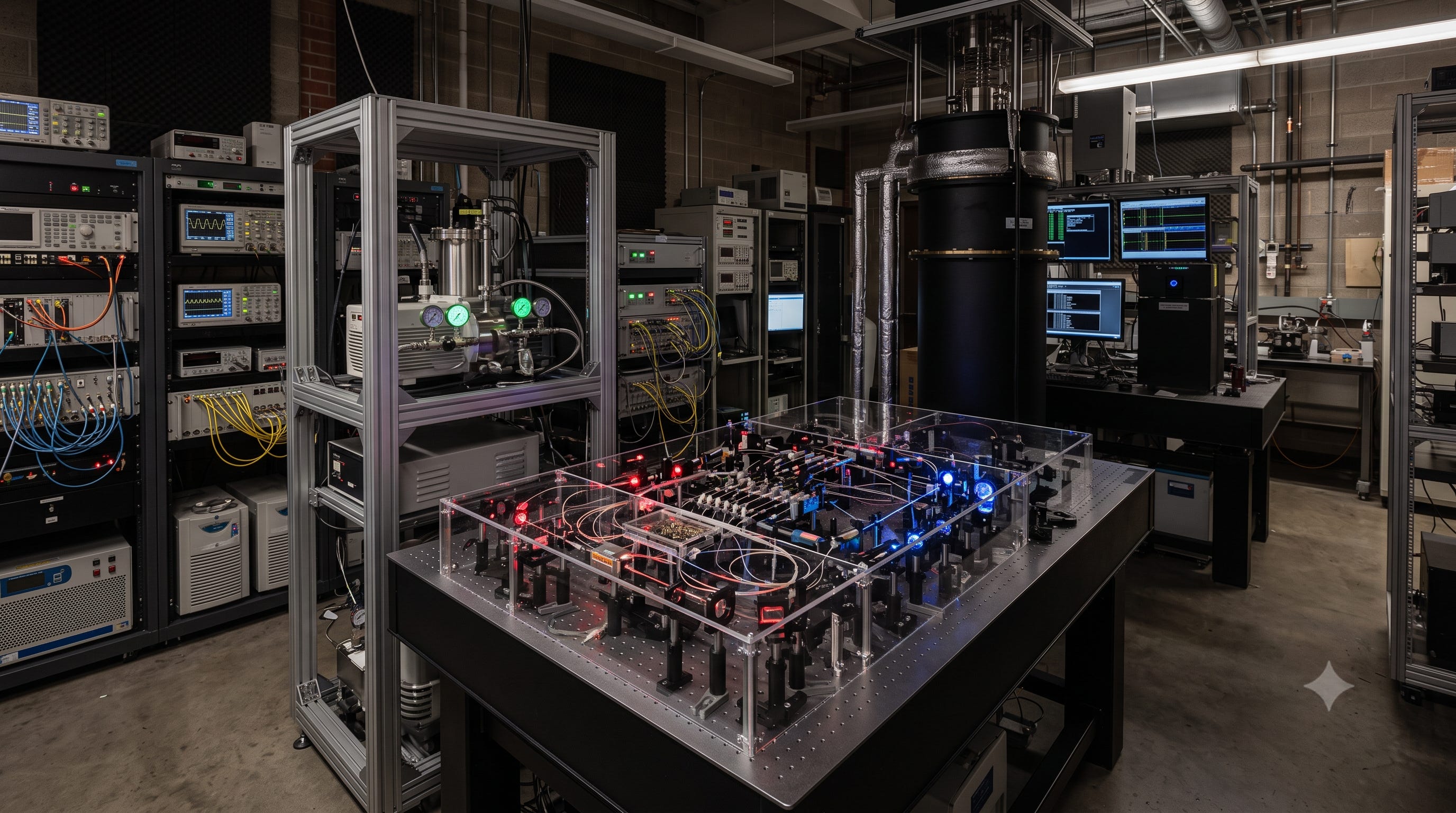
Image credit: Google Gemini
Last Updated on Sunday, July 05, 2026, at 12:10 PM EDT
Our Daily Quantum Update breaks down recent news into categories to make it easier for you to find the industry developments in which you are most interested. These articles don’t always explain what the core technology is or how it works. Luckily for us, there are some great resources on the web that do.
In each installment of this type of post, we’ve listed some of the best explainer pieces by authors like Russ Fein and Martin Ivezic, as well as by companies developing the technologies. For the latter group, we’ve tried to pick content rich in understandable technical signals and low in marketing noise.
We have not included deep research articles in these collections, though there might be a good survey article that sneaks in. We’ve tried to include content for beginners, enthusiasts, marketers, investors, policy makers, and, really, anyone who wants to learn more about the topic. Scan the listing and start with something that appeals to you. Jump around until you find something that is at your level of understanding and interest. The newest articles are at the top, with older ones appearing lower as you go.
Below the article links are references to other modalities covered in this series.
When we speak of quantum computing, the “quantumness” is usually exhibited by the behavior of electrons or photons. For example, we can model a two-level quantum system using vertical and horizontal polarizations, which, by the way, is how polarized sunglasses work. There are other ways to get two-level systems with photons, as there are with electrons. This is why there are so many submodalities within the implementation types of quantum systems. The linked articles below demonstrate the possibilities and some vendor choices.
Extra credit: When do we need ultra-low-temperature cooling for photonic quantum computers and why?
Linear optical quantum computing
A paradigm of quantum computation using photons as information carriers, linear optical elements to process quantum information, and photon detectors and quantum memories for detection and storage.Published or Last Updated: June 2026
Source: WikipediaQuantum Computing Modalities: Photonic Cluster-State
Photonic Cluster-State Computing is a form of quantum computing in which information is processed using photons that have been prepared in a highly entangled cluster state.Published or Last Updated: June 2026
Author: Marin Ivezic
Source: PostQuantum.comTaxonomy of Quantum Computing: Modalities & Architectures
Why multiple quantum computing paradigms? The goal is the same – realize a scalable, universal quantum computer – but the approaches differ.Published or Last Updated: May 2026
Author: Marin Ivezic
Source: PostQuantum.comPhotonic Quantum Computing: Light as Qubits at Fab Scale
PsiQuantum’s Omega chip hit 99.98% SPAM at GlobalFoundries. How photonic QC works, who builds it, and what fab-scale photonics means.Published or Last Updated: May 2026
Author: Marin Ivezic
Source: PostQuantum.comQubit Modalities: Photonic Quantum Computing
The fourth installment in Fein’s qubit modalities series, covering the physics and engineering of photonic QC, key challenges such as photon loss, and a current state-of-the-field comparison of leading companies.Published or Last Updated: May 2026
Author: Russ FeinRecent Progress towards Large-Scale Integrated Photonic Quantum Computation
An open-access review of integrated photonic platforms and key components — single-photon sources, reconfigurable circuits, and squeezed light — covering NISQ-era applications and the path toward universal fault-tolerant photonic quantum computing.Published or Last Updated: March 2026
Author: Huihui Zhu
Source: npj NanophotonicsPhotonic Quantum Computing
A comprehensive survey of photonic quantum computation covering both discrete-variable and continuous-variable approaches, from foundational principles through current architectures and implementations.Published or Last Updated: October 2025
Authors: Jacquiline Romero and Gerard Milburn
Source: arXivQuantum Computing Modalities: Photonic Continuous-Variable QC (CVQC)
Photonic continuous-variable quantum computing (CVQC) is an approach to quantum computation that uses quantum states with continuously valued degrees of freedom, such as the amplitude and phase of light.Published or Last Updated: September 2025
Author: Marin Ivezic
Source: PostQuantum.comPhotons Light the Way to Useful Quantum Computing
A readable feature covering PsiQuantum, Xanadu, and ORCA Computing — their technical approaches to photonic QC, the central challenge of photon loss, and their roadmaps toward fault tolerance.Published or Last Updated: June 2025
Author: Susan Curtis
Source: Optics & Photonics NewsQuantum Computing Modalities
A Qubit Primer Re-Revisited in December 2024 — a summary of different quantum computing modalities including relative strengths and weaknesses.Published or Last Updated: December 2024
Author: Russ FeinPhotonic Quantum Computers
A comprehensive overview of photonic quantum computing focusing on industry players including PsiQuantum, Xanadu, and Quandela, examining current performance, architectural designs, and strategies for large-scale fault-tolerant systems.Published or Last Updated: September 2024
Author: Muhammad AbuGhanem
Source: arXivPotential and challenges of quantum computing hardware technologies
Many qubit technologies could shape the future of quantum computing hardware. Here, we take a closer look at five of the major qubit technologies: photonic networks, superconducting circuits, spin qubits, neutral atoms, and trapped ions.Published or Last Updated: December 2023
Authors: Martina Gschwendtner, Niko Mohr, Nicole Morgan, and Henning Soller
Source: McKinsey & CompanyLight in quantum computing and simulation: perspective
A paradigm of quantum computation using photons as information carriers, linear optical elements to process quantum information, and photon detectors and quantum memories for detection and storage.Published or Last Updated: October 2023
Author: Ian Walmsley
Source: Optica Quantum
Also See These Starter References in This Series
Quantum Starter References: Quantum Computing Systems and Components – Neutral Atom Qubits
Quantum Starter References: Quantum Computing Systems and Components – Superconducting Qubits
Quantum Starter References: Quantum Computing Systems and Components – Trapped Ion Qubits
Quantum Starter References: Quantum Computing Systems and Components – Silicon Spin Qubits
Sutor Group Intelligence and Advisory
Dr. Bob Sutor is CEO and Founder of Sutor Group Intelligence and Advisory. Drawing on more than four decades of experience across startups and large corporations, Sutor Group advises Deep Tech startups, enterprises, governments, and investors on quantum technologies and other emerging fields, pairing market insight with deep technical expertise.
The firm shares its work through client engagements, seminars, reports, newsletters, books, media appearances, and speaking and panel moderation at leading industry conferences and client events.
Legal Stuff
Visit the Copyright, Notices, Disclosures, Disclaimers, and Licenses page on the Sutor Group website for applicable legal information for this content.